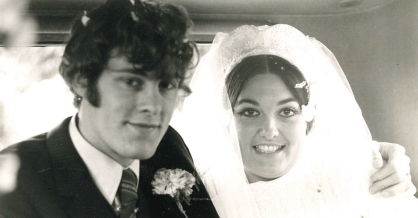

My name is Gwenda, and for fifty wonderful years, I was married to an amazing man named John.
He was a Yorkshireman, which meant he was plainspoken, he was also one of the kindest, most thoughtful people I have ever known. He loved art, history and books. He loved being out in the garden, or disappearing off
with me to visit a historic castle.
We met in our early twenties. John came out canvassing with me in the lead-up to a local election. I thought he was interested in politics – but it turned out he was just interested in me!
Six weeks later, we were engaged. I knew I loved him, he asked me, I said yes, and that was that. It was the best decision I ever made.
In 2019, following emergency surgery, we were given news that left us speechless: John had bowel cancer.
John was optimistic, but shortly after his chemo began, COVID-19 plunged the UK into lockdown and as time went on, he became ill again and was admitted to hospital intermittently.
Because of pandemic restrictions, I wasn’t allowed in to visit him, and his frequent bowel troubles made him feel like a burden to the hospital staff, leaving him frightened and isolated.
When he was finally discharged in March 2022, he vowed never to return to hospital.
For a while, community nurses would come to our home to change his dressings, and leave hardly saying a word to John or to me. We never knew when they would arrive, and we felt we couldn’t even leave the house for fresh air.
John’s wishes were to stay at home for as long as possible, he didn’t want to die at home—I believe he made that choice to protect me. When asked where he would prefer to die, John said he simply wanted to be “Somewhere where people know how to care for people who are dying.”
That was when Isabel Hospice came into our lives. The difference was extraordinary. I will never forget the first time the Isabel Hospice at Home team came through our front door. One of the nurses looked at me and said, “How are you?”
Such a small question. But until that moment, nobody had asked me how I was coping, and I cried because it truly meant the world.
They were punctual, reliable, and brought joy into our home. They had a super relationship with John and gave me ways of helping, like making specific drinks for him, so I still felt able to do something for the man I loved—and gosh, that matters.
When John finally became too ill to even leave our bedroom, a kind, young, male paramedic from Isabel Hospice arranged for a bed at their Inpatient Unit and guided John down our stairs effortlessly to get him there. “Isabel Hospice gave me beautiful final moments with my husband”
From the moment we arrived, the atmosphere felt completely different to the hospital.
The staff welcomed him warmly and spoke directly to him about what he wanted. He was not a problem to be managed. He was a human being.
There was no issue at all regarding his bowel care; they quickly established his needs, adjusted his medication to make him comfortable, and gave him back his dignity without him ever feeling like a burden.
The staff were brilliant and funny, and John and I laughed together again. I had not seen him so relaxed for a long time.
On his final day, I had just popped out and within a few minutes, the hospice called and asked me to come back.
When I returned, John’s room was full of love, with staff holding his hands and talking to him so he wasn’t alone. They hugged me, and John died shortly after I arrived.
Isabel Hospice gave John the space to die. They allowed him to feel safe, cared for and calm enough to let go. And while they were caring for him, they gave me the space to love him completely as his wife, not his carer.
After John died, I asked, “What now?” and a lovely nurse asked if I would like to help wash him. It had never occurred to me that I might wash my husband after he died, but it was the most beautiful thing. A doctor described it as “the final act of love.” That is exactly what it was.
John and I usually spent Christmas at home together, just the two of us, and we loved it. But, after he died, I realised how important it was to be around others. That is why the Lights of Love services have become so important to me.
I do not know many of the people there, but it does not matter. There is something very comforting about coming together with people who have had a shared experience of loss, and at some point, in that loss, Isabel Hospice was there for them, too.
If you have never been to a Lights of Love service, I strongly encourage you to try it, and if you can, please support Isabel Hospice by making a dedication and a donation today.
Because somewhere, another family needs someone to walk through their door, look at them, and simply ask, “How are you?”